If you work in marketing in Finland, this question is already in your Slack. In many of my marketers’ communities, “how do I make my company appear in AI overviews?” is a regularly asked question, next to questions about salary reports and tax cards. Everyone is asking it, yet most answers are vague and confusing. So here is my take, to throw into the confusing sea of answers.
What is the difference between SEO and appearing in AI results?
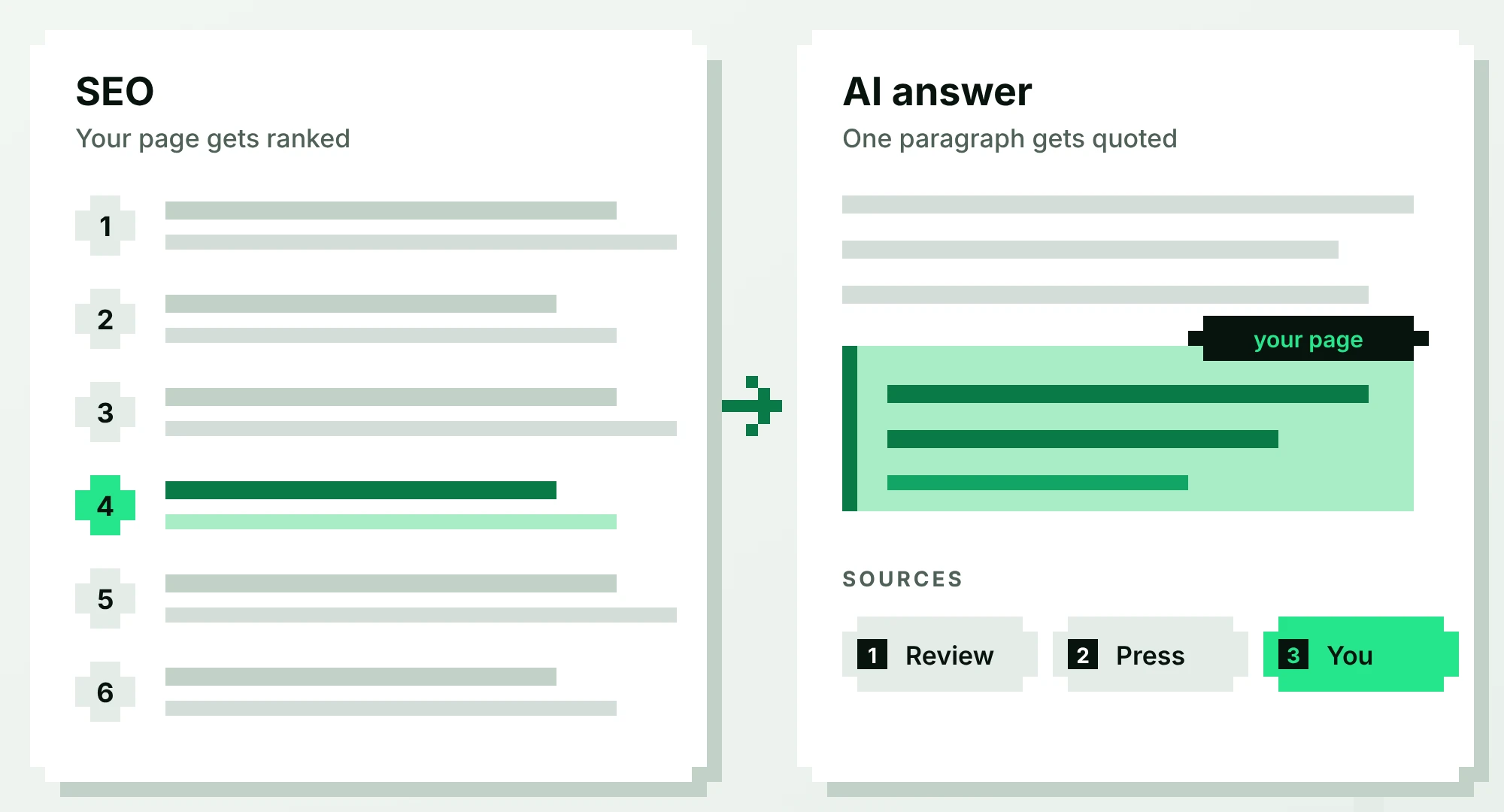
SEO gets your page ranked. AI optimisation (GEO or AEO) quotes your website content inside an answer made by AI engine.
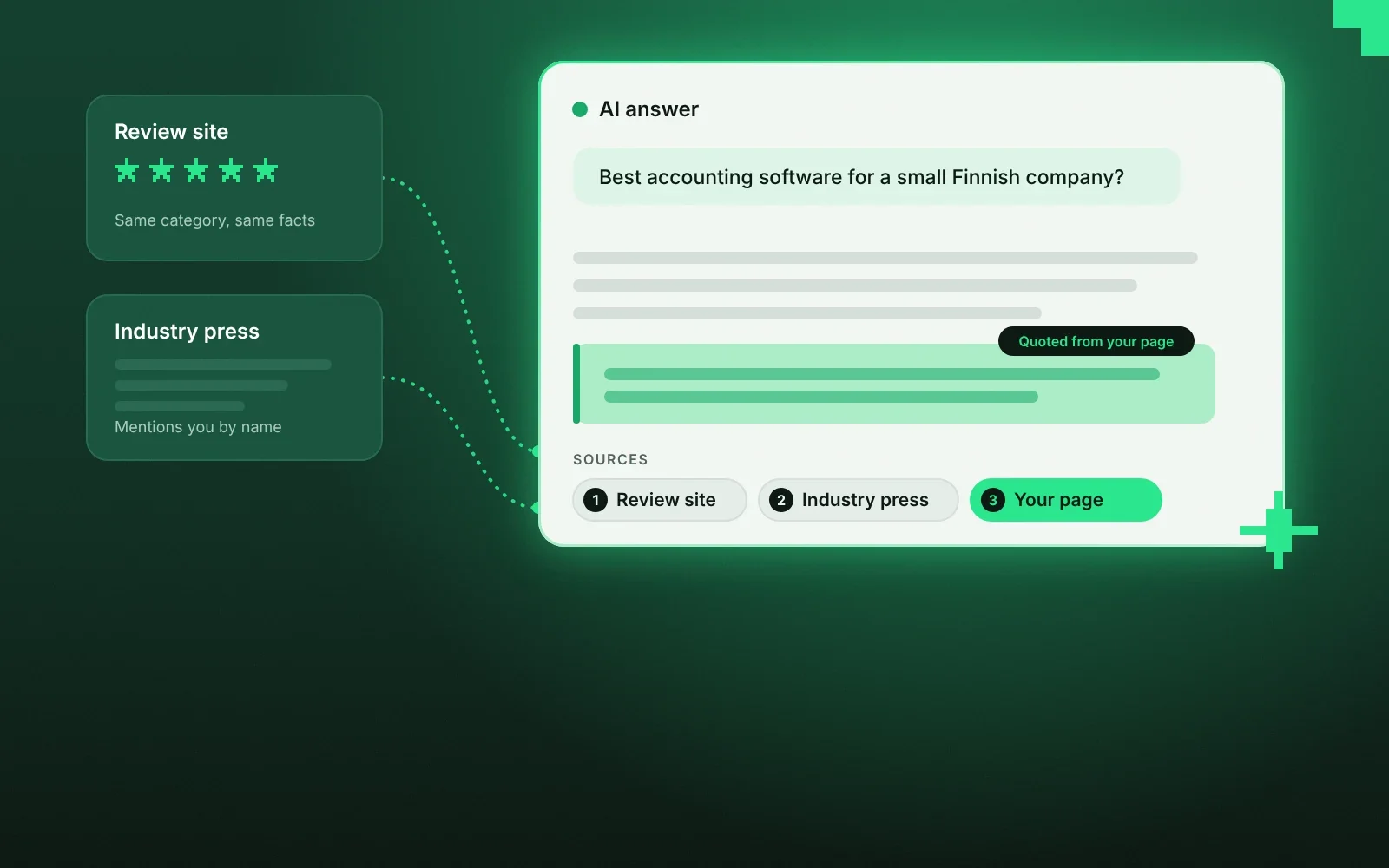
Example case: A buyer opens a new tab in their browser and asks – “best accounting software for small company Finnish laws”. They do not see a sea of blue links, like they used to in the past. Now, most likely at the very top, what they will see is one fused answer with multiple sources.
Your page could be one of those sources even if you do not rank on page one, because AI engines select parts of your content, not pages. These engines pick the paragraph that answers asked question in the clearest manner.
Of course, there is quite a bit of variance in how each AI tool selects what to quote, and to be frank, we do not know a lot of it. But some of what we do know is, for example:
- Google AI Overviews and AI Mode are built on its core ranking and quality systems, so they do not care as much about special markups.
- On the other hand, other engines such as ChatGPT, Claude, and Perplexity lean much harder on site structure (such as markups and schema) and what other websites say about you (mentions and backlinks).
So you should still make sure your content is SEO friendly, while at the same time making small changes to the structure in which it is presented not only to human readers, but also to the bot readers.
How do AI engines choose which sources to cite?
AI engines primarily weigh three things:
- whether a passage answers the question directly,
- whether the website and its content look trustworthy,
- and whether other sources agree with the content.
| Signal | What AI engines look for | What you can do |
|---|---|---|
| Directness | The answer appears right under the heading, usually as the first sentence. | Begin every section with the answer, then explain |
| Evidence | Named sources, specific numbers, dates | Cite the original study, not a blog that summarised it |
| Authority | A real author with relevant experience, recent updates | Add a byline, bio and “last updated” date |
| Consensus | The same facts about you appear on other sites | Keep G2, Capterra, LinkedIn, other profiles relevant to your industry and your own site consistent |
The most-cited research on this is the Princeton GEO study (Aggarwal et al., KDD 2024). It tested nine tactics on generative engines. Adding source citations, statistics and expert quotations raised visibility the most, while keyword stuffing lowered it. The takeaway is plain: as with modern SEO so with GEO -> quality and proof beats keywords stuffing.
What can you change on your website this week?
Five changes, in order of effort:
- Add the summary of the page in a few sentences: State what the page is about and who it is for. An AI engine should be able to lift those two sentences and have a complete answer.
- Turn headings into the questions buyers type: “Pricing” becomes “How much does [accounting software name] cost for a team of 20?” Then answer in 40 to 60 words before going deeper.
- Add a comparison table wherever it makes sense: Tables are easy for engines to quote and easy for buyers to scan.
- Put numbers on claims and date them: “Fastest on the market” is invisible for AI. “Average onboarding time for [accounting software name] has reduced from 9 days to 4 in Q2 2026” can be cited. Use only numbers you can back up.
- Wherever possible, publish your pricing clearly: If an AI agent comparing tools for a buyer cannot read your price, it recommends a competitor whose price it can read. A simple pricing page is enough, and an llms.txt file is a cheap addition. If you sell a service like agency work and cannot publish fixed prices, publish price ranges or example project costs, so AI has something to quote.
Do not write a separate “AI version” of your content or chop pages into tiny fragments. Google’s guidance warns against both, and the pages read worse for humans.
Where else do AI engines look besides your own website?
They also look at what other people say about you. In one analysis cited in AI-visibility research, brands were far more likely to be mentioned through third-party sources than through their own domains. For a B2B SaaS company, that means:
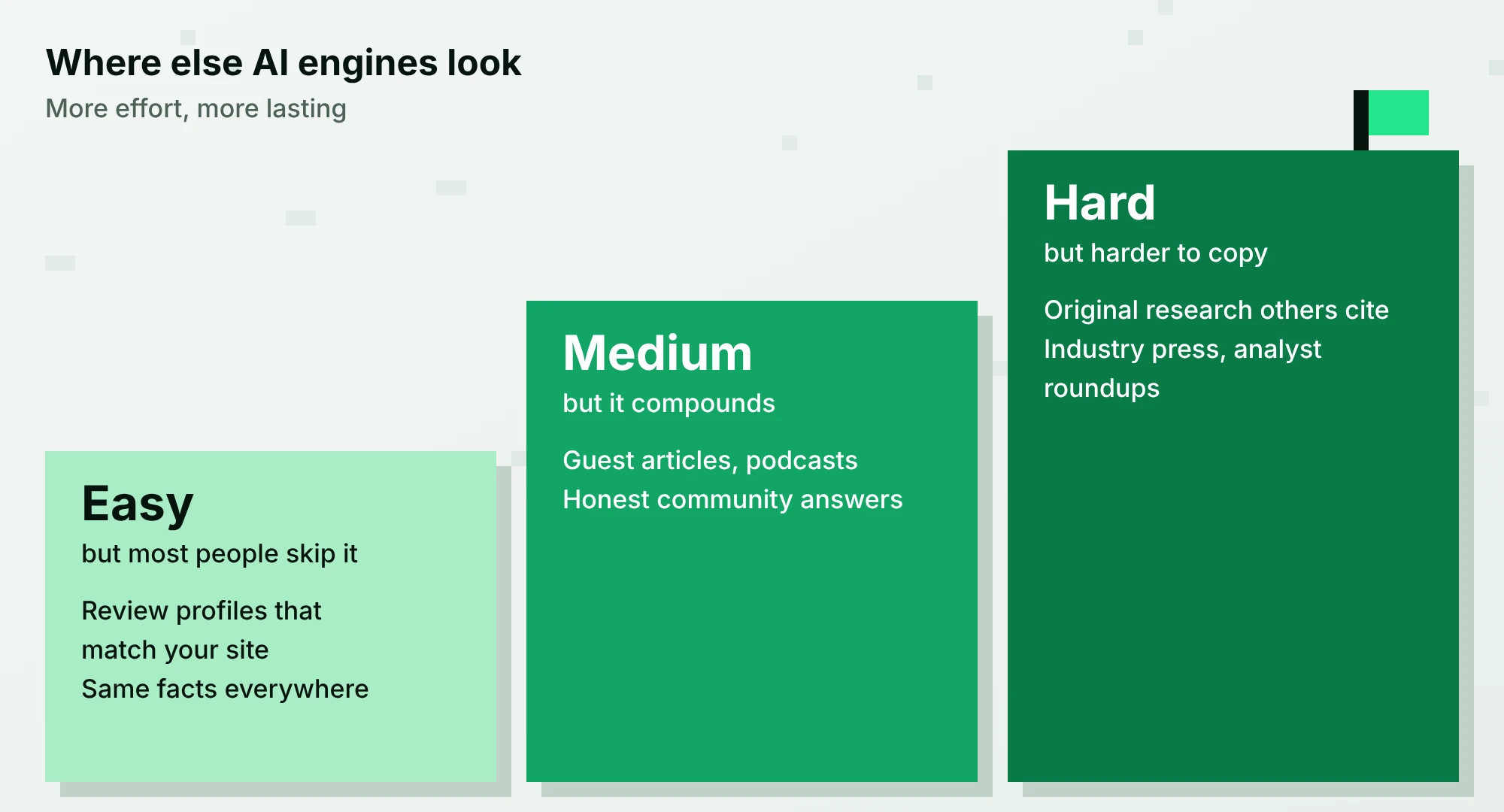
Easy, but most people skip it:
- Review profiles on G2, Capterra or TrustRadius that match your site’s description
- Consistent facts everywhere: product name, category, pricing model, who it is for
Medium, but it compounds:
- Guest articles and podcast appearances in your category
- Honest participation in communities, where you answer questions without pitching
- A Wikipedia entry, if your company meets its rules and someone independent writes it
Hard, but harder to copy:
- Original research that other sites cite, such as an annual benchmark report built from your own customer data
- Coverage in industry publications, press and in analyst or comparison roundups, which usually takes months of relationship-building
A caution: being cited is not the same as being recommended. A page can be cited for a definition while the answer still recommends a competitor. Recommendations follow reputation across the web, so treat your own content as the start of the work, not all of it.
How do you know if it is working?
Run a monthly check by hand. Pick 20 queries your buyers would ask, run each through ChatGPT, Perplexity and Google, and log whether you are cited, who else is, and which page was used. A spreadsheet is enough. Tools such as Otterly, Peec AI and ZipTie automate this at scale.
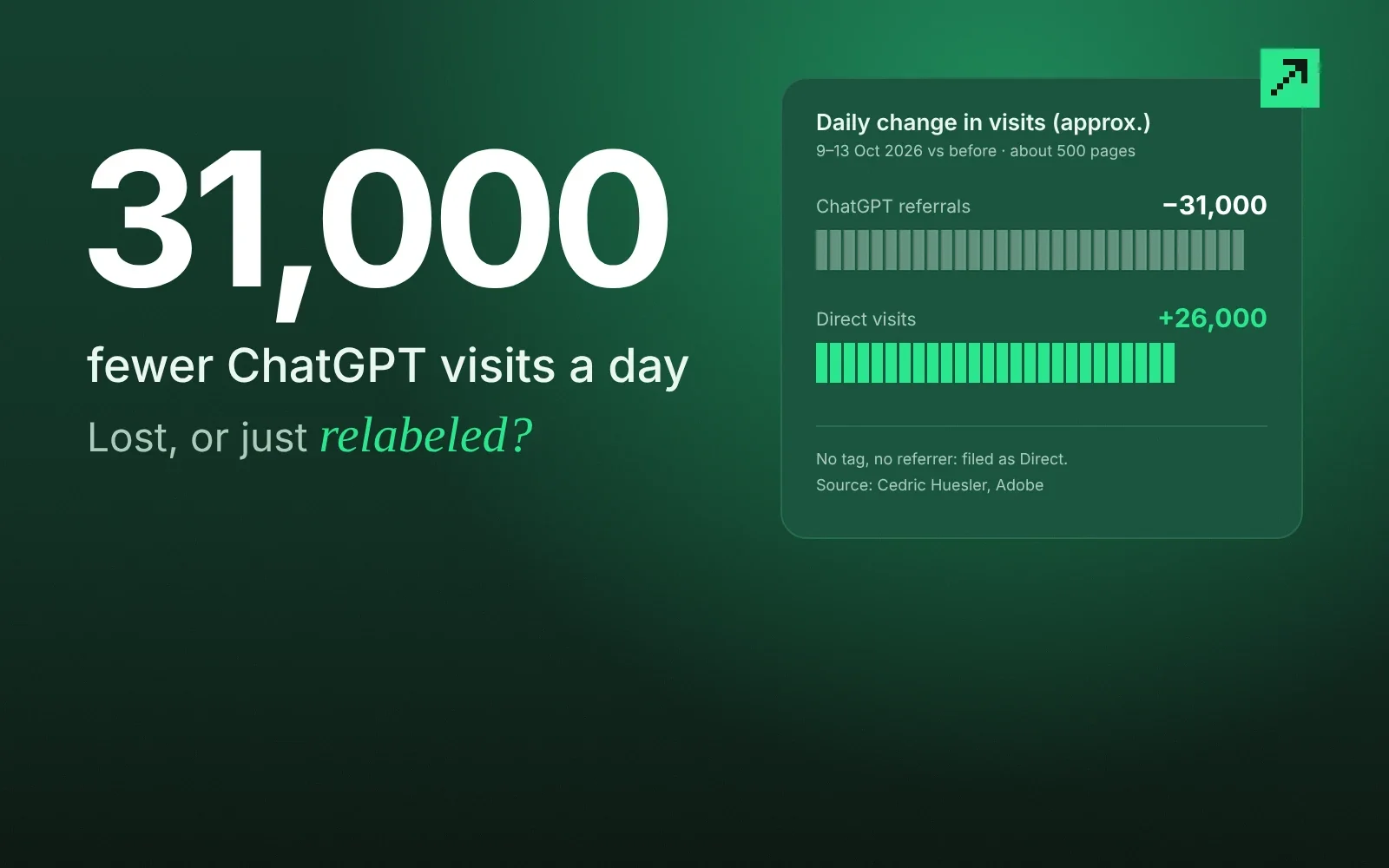
Also check your analytics before you judge the result. AI referral traffic is often mislabeled as direct visits, which I cover in a separate post: Why does ChatGPT traffic show up as Direct in Google Analytics?
Sources
- Aggarwal et al., “GEO: Generative Engine Optimization,” KDD 2024
- Google Search Central, “Optimizing your website for generative AI features on Google Search”
- Weekly B2B Marketing Digest (Deivis Rupslaukis), commentary by Brendan Hufford on AEO needing both systems and judgment, week 43, 2026
Questions
What is the difference between GEO and AEO?
Both mean optimising content to appear in AI-generated answers. AEO (answer engine optimisation) is the older term, tied to featured snippets and voice answers. GEO (generative engine optimisation) describes AI systems that write answers by taking several sources. In practice, the work is the same.
Do I need schema markup to be cited?
Google says structured data is not required for its AI features. It still helps other engines and traditional search understand who wrote a page, when it was updated and what questions it answers. BlogPosting and FAQPage are the useful starting points.
Should I block AI crawlers?
Only if you are okay with losing citations from that engine. Blocking GPTBot, PerplexityBot, ClaudeBot, or Google-Extended means those systems cannot cite you. Many sites block only training-focused crawlers such as CCBot.
How long does it take to see results?
Pages are re-crawled on different schedules, so expect weeks, not days. Fresh dates and real updates help, since AI engines favour recent content on fast-moving topics.
Does ranking on Google still matter?
Yes. Google AI Overviews draw heavily on pages that already rank. Treat SEO as the foundation and the steps above as the layer on top.