Picture yourself, a founder of a SaaS company, one in a million, with a good working product, your website getting decent traffic. Visitors arrive, look around your site and leave. Barely anyone follows up with anyone who signed up or downloaded any gated content. The monthly report is still a Google Sheet doc; someone manually updates it every Monday morning (5min before the Monday morning call, remembering they have to present what happened last week).
You don’t need a bigger ad budget; you don’t need more content no one gets to anyway; what you need is someone to connect all the pieces. That someone has a name now, and this title is slowly getting more recognition: a marketing engineer.
So, what does a marketing engineer actually do?
To sum it up simply – a marketing engineer is a hybrid marketer who combines practical hands-on marketing skills with technical skills, building skills, data and AI workflow creation. They both build your marketing machine and keep it running smoothly.
Marketing engineer responsibilities include:
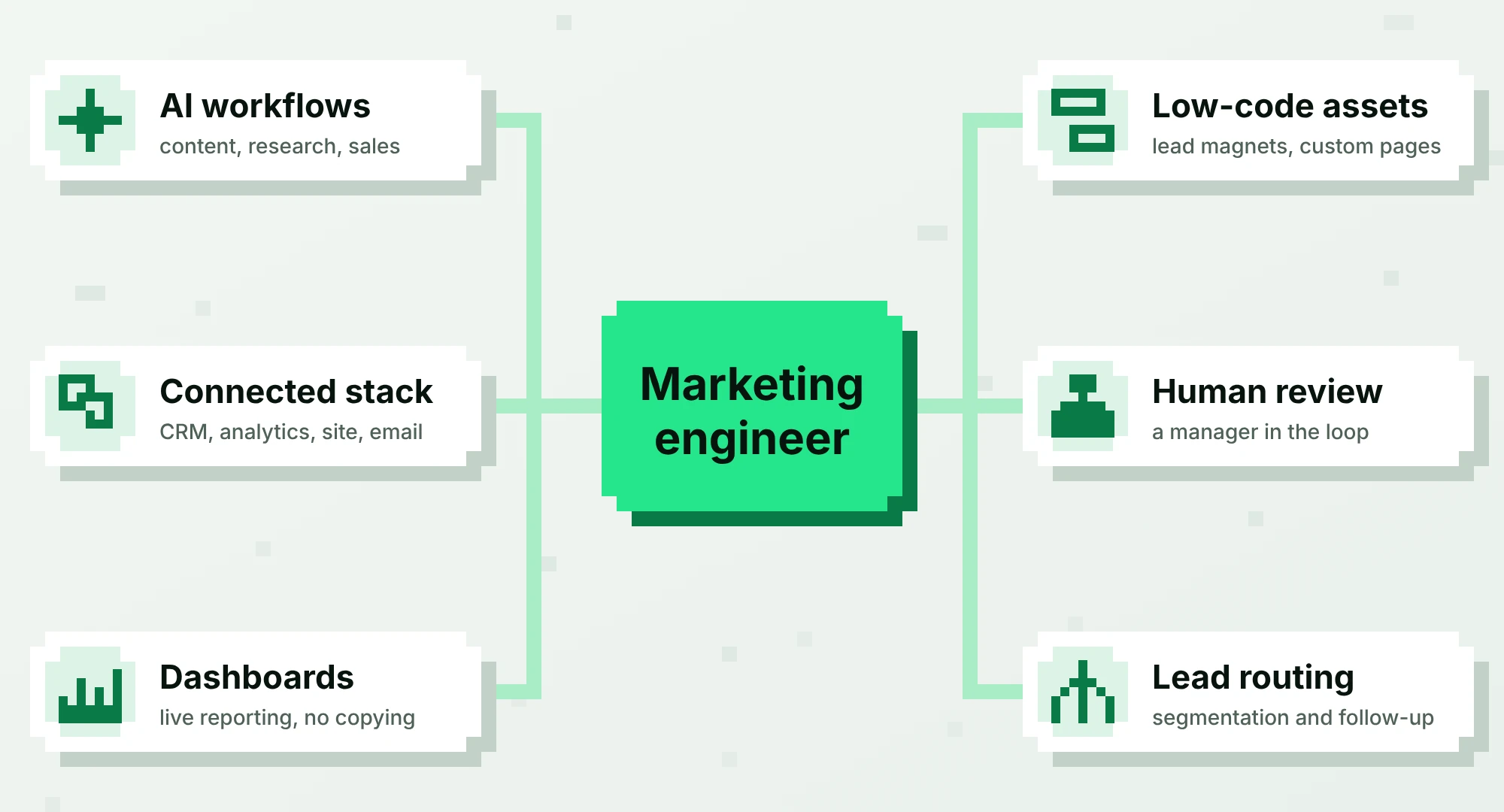
- Building AI-assisted workflows for content, messaging, sales enablement, or prospect research, using AI tools, instead of starting with a blank prompt every time.
- Connecting the full marketing & sales stack: CRM, analytics, website and email feed each other, so information flows from the first click to a closed deal without anyone copying numbers between tabs.
- Creating dashboards or reporting systems: improving reporting flow and making data actually usable inside marketing and sales activities.
- Create low-code marketing assets on the go: an interactive lead magnet, a custom page for each buyer type, an automated loop that distributes every new article.
- Designing human-in-the-loop systems: being aware that even with agents, just like with human employees, a manager serves a purpose.
- Creating structures for AI systems for the whole marketing & sales departments. Whether it be prompt libraries or workflows, providing the rest of the marketing and sales company with the developed tools is essential.
- Designing lead conversion logic through AI-optimized lead routing, segmentation and follow-up logic.
- Still having the general marketing skills: marketing engineers understand the customer, the positioning and what good copy looks like, because a system built without understanding will generate basic slop.
Marketing Engineer VS Growth Engineer VS Growth Marketer VS Traditional Marketer
It feels as if nowadays everyone is just coming up with new titles daily, to the point that no one really knows when to use which. While there is no official, globally agreed definition for either of these roles, these are some of the common differences between marketing engineer and some of the other similar marketing titles.
| Role | Marketing engineer | Growth engineer | Growth marketer | Traditional marketer |
|---|---|---|---|---|
| Scope | Primary: Acquisition (top-of-funnel: campaigns, content pipelines, and attribution) Secondary: Activation (turning traffic into leads or users) | Full-funnel (AARRR: awareness, acquisition, activation, retention, referral) | Full-funnel (acquisition, activation, retention, referral, revenue), run through constant experiments | Top-of-funnel: brand awareness and demand generation through planned campaigns and channels |
| Whom do they work with? | Typically marketing department (reports to CMO) | Cross-functionally between product, engineering, and data | Sits between marketing, product and data teams | Marketing department |
| Typical output | AI content production workflows, review generators, competitive bots, and attribution dashboards | In-app experiment tooling, onboarding flows, referral loops, and lifecycle infrastructure | A/B tests, landing page and funnel fixes, growth loops, paid and organic channel tests | Depends on their particular specialty -> could be SoMe, paid, blogs. |
| Core question | “How do we get more and better leads?” | How do we move activation and conversion inside the product?” | “Where is the biggest drop-off in our funnel, and what can we test to fix it?” | “How do we get our brand and message in front of the right people?” |
| Key metrics | MQLs, pipeline growth, and, marketing-attributed revenue | Growth rate, activation, retention, and compounding metrics | Conversion rates, retention, LTV, and revenue growth | Reach, brand awareness, market share, and sales volume |
A growth engineer usually works deep in the product codebase, on activation and conversion loops inside the app.
A growth marketer stays on the marketing and go-to-market side: content pipelines, SEO, GEO / AEO, research and campaign infrastructure.
A traditional marketer uses AI or software to draft copy or run ads.
A marketing engineer builds the underlying system and workflow that lets the team do that consistently.
Marketing operations keeps the foundations stable, and a marketing engineer builds new systems on top of them.
Nowadays, in a small team one marketing employee often wears two hats. The title matters less than whether someone owns the system.
Does your team need a Marketing Engineer?
There is no clear yes or no, however, I did make a quick checklist to hopefully help you identify if there might be a need:
- Do you already have traffic, but it isn’t converting? (+1 if answer is yes)
- Do you have leads, but most of them don’t go anywhere? (+1 if answer is yes)
- Is your marketing and sales reporting still done manually? (+1 if answer is yes)
- Are your marketing and sales tools connected to one another? (+1 if answer is no)
- Do you have your clear marketing weaknesses defined?
Outcome: if your total is above 1, a marketing engineer is worth considering.
Should you hire a marketing engineer in-house or get an agency?
In my personal experience, marketing engineering usually serves best as an in-house role. However, for some smaller teams that might need only some help with foundation and workflows, an agency or a freelancer could be a low-risk way to test the waters and see if this is a role they would need full-time.
Things to keep in mind:
- Usually longer hiring times
- One marketing engineer rarely covers all marketing needs
- Freelancer or agency only best when you just need systems built and/or tuned
So what do I do next?
Do the same principle I do any time before buying a new house appliance: after getting the idea in my head, I start writing down every time I actually would have needed it. Not wanted, not found it useful, but actually needed it.
Look at your company’s marketing processes, and see what is working, what isn’t and if it is something that a Marketing Engineer would solve.
Questions
What is a marketing engineer?
A hybrid builder and marketer who creates the systems, automations and AI agents that power a marketing team, so campaigns run consistently instead of by hand.
Is a marketing engineer a developer or a marketer?
A bit of both; it depends on the case, which is stronger. Some might come from marketing background and others from more of a technical background, but they both sit at the intersection, are comfortable with data, code-light tools.
Can a marketing engineer be a freelancer?
Yes. However, usually for long-term complicated projects I recommend hiring a marketing engineer in-house. However, if you only need some help with foundations or some particular workflows, a freelancer can be a low-risk way to test the waters.
Do all startups need a marketing engineer?
No. A Marketing Engineer becomes more useful when the basics exist, but the next steps are lacking. If you have no product-market fit yet, fix that first. If you have product-market fit but are lacking growth, I would rather look at Growth Marketers or AI-Native Growth Marketers.
Can AI fully replace a marketing engineer?
At least not yet. 😀 AI can do a lot of the heavy lifting, but someone still needs to decide what to build, how to build it, create the workflows, check the outputs, and own the results.